Visitors to London’s British Museum can admire a remarkable example of Roman ingenuity that’s considered one of the seven glass wonders of the world. Dated to the fourth century, the ornate Lycurgus Cup is a soft jade green — or a striking ruby red, depending on where the light source is positioned.
The goblet’s color-changing capability has long perplexed scientists. No one is sure exactly how it was created, but the consensus is that Romans added tiny bits of gold and silver to their glass mixture, forming layers of nanoparticles that interact with light differently depending on their size and shape.
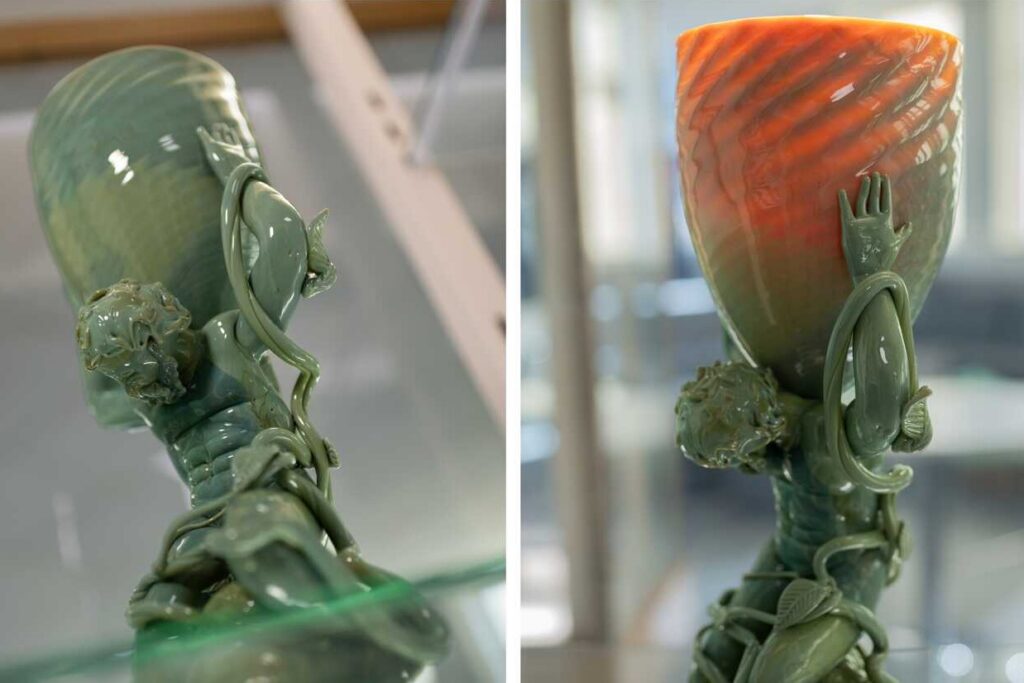
Experts had struggled to devise a reliable method of re-creating the material in quantity, but now, for the first time, the mystery appears to have been solved. Melding an ancient recipe with modern science, a glass specialist from the University of Sheffield has reproduced the effect, and commissioned a sculpture that pays homage to the original.
Lisa Hollands, with the institution’s School of Chemical, Materials, and Biological Engineering, took on the challenge, which was “very much a labor of love,” per a news release from the university. She worked with a Roman glass expert to develop a base that mimicked those used nearly two millennia ago, then set about experimenting with different furnace types, oxygen levels, and more.
She said she knew it would be a much more complicated task than simply sprinkling some gold and silver nanoparticles into a mixture, but did think at one point, “If the Romans could have seen me experimenting, they’d probably laugh and ask: ‘Why does she not know how to make this?’”
Finally, Hollands landed on a recipe for glass that looked opaque green under reflected light but red when a light was shone directly on it. “To me, it’s magic,” she told The Guardian.
So how exactly does it work? “White light is made up of many different colors and you see this when there is a rainbow in the sky. Nanoparticles are much smaller than the wavelengths of light and in certain conditions they block certain colors due to the light affecting the electrons in the atoms,” she explained to the outlet.
“So, for this glass, if light is shone through it, the gold and silver particles block blue and green light, only allowing reds and oranges to pass through. If light is reflected off the surface, the particles have the effect of scattering the light, giving the opaque green color we see,” she continued.
Hollands and her project manager approached U.K. glass artist Elliot Walker, who won Season 2 of Netflix’s Blown Away, to create a finished piece that could be exhibited at Sheffield’s upcoming Festival of the Mind, which runs Nov. 6-15. It will then go on permanent display at the university’s Turner Museum of Glass.
“You can really get an idea of how the glass makers of the past would have adapted to this sort of glass; it’s like shaking their hands,” Walker said in the release.
The Lycurgus Cup depicts the legend of King Lycurgus from Homer’s Iliad, showing the triumph of the Greek god Dionysus over the lawgiver Lycurgus. The 2026 homage bridges the time between the Roman artwork and now.
“I wanted to keep the sculpture quite classical in form and to carry through the original story of Lycurgus shown on the cup, but we needed a blown element within this to really show the dichroic glass,” said Walker. “The piece is a blend of the Lycurgus story and the Farnese Atlas sculpture, with the globe replaced by a cup.”