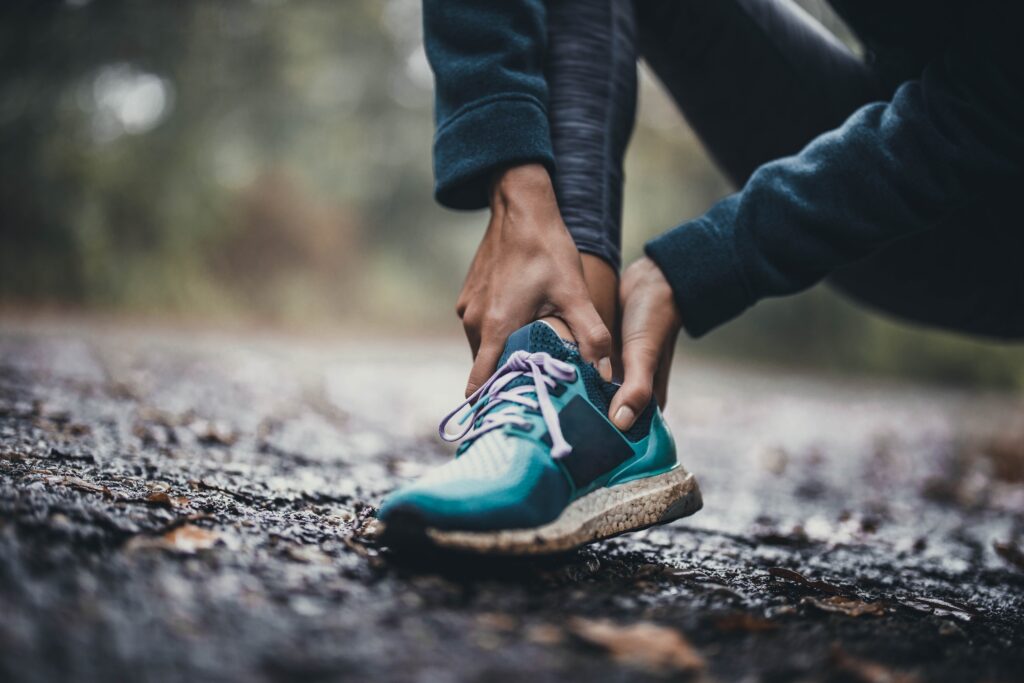
We all know what to do when we sprain an ankle or strain a calf muscle: rest it, ice it, compress it, and elevate it, right? Wrong, actually. That protocol, known as the RICE method and introduced by a sports medicine physician in 1978, is no longer the recommended route for helping soft-tissue injuries heal.
In July, The Washington Post published an article titled, in part, “There’s a new way to treat sprains and strains.” But it turns out that the approach the piece presented isn’t really new at all — it’s been around for seven years. Even before that, the Rest-Ice-Compression-Elevation method was on its way out. In 2015, the doctor who came up with it wrote that updated research suggests it may delay healing.
We can’t fault the Post for its word choice, though: Many people are unaware that the old standard has been supplanted, much less why. To clarify matters, Nice News spoke to three medical experts who broke down the problem with RICE (spoiler: the issue is really just with the “R” and the “I”) and explained the acronyms that providers are increasingly embracing instead.
The Issue With Ice
When we injure our soft tissues, our bodies activate an inflammation response and we start to swell. It was once thought that reducing this inflammation was key to healing, so ice and NSAIDs — anti-inflammatory drugs like Advil — were prescribed to ease the swelling.
The trouble is that swelling in this early stage is generally a positive; it’s the result of increased blood flow and fluids that deliver healing factors, and while too much swelling can be cause for concern, suppressing the normal response may impede the healing process.
John DeLucchi, an orthopedic physical therapist and director of digital recovery for musculoskeletal care access platform HURT!, described the issue in layman’s terms.
“Swelling kind of brings in the workforce to help with an acute injury during that initial and kind of subacute inflammatory stage,” he explained, adding: “It would be similar to if I have a huge pothole or a sinkhole in the street, but I didn’t allow any of the public work people to come by and actually fix that problem, right?”
Sports medicine physician Jacob Luther, with Endeavor Health, elaborated: “If you want to get really technical with it, what’s happening is there are certain molecules called neutrophils and macrophages, which are responsible for helping kind of clean up the injured tissue, kind of removing some of the damaged area. And those aren’t getting transported to the area as quickly if ice is applied to it.”
Because ice numbs the area, it does have a role to play — that of a pain reliever. And as such, it’s probably fine to use during the first six hours or so, Luther said. Additionally, Tylenol, which is not an NSAID and thus doesn’t target inflammation, may be a better choice than ibuprofen for pain relief.
What About Rest?
Taking it easy in the immediate aftermath of an injury is fine, but when it comes to getting back on your feet again after an injury, you pretty much have to do just that: get back on your feet again. When we avoid all pressure on the area or use crutches for weeks, we’re likely doing more harm than good.
It’s all about timing “optimal loading,” or placing the ideal amount of pressure on the affected body part — because some pressure is good: It brings those beneficial fluids and blood cells to the area.
Ashley Katzenback, an athlete and physical therapist on Cape Cod, Massachusetts, explained that when, for example, someone sprains their ankle on the playing field, a trainer will often apply ice, wrap the joint, and instruct the athlete to stay off it. “But the reality is, if they came off the field, [were] assessed to make sure there wasn’t a tear, and then [were instructed to] walk around on it, they’re actually going to feel better because it’s that loading and unloading or compression and decompression of the joint that reminds our body that it’s safe.”
She added: “Whereas we stop moving, all of that fluid collects, and we ice it so the blood cells constrict — everything just gets stuck there. And oftentimes it’s that feeling of stiffness that hurts, versus movement actually is going to make you feel better.”
DeLucchi also emphasizes active recovery in his practice. He said that in the very early stages of an injury, rest and ice can still be useful, and that treatment plans vary case by case. But “in most instances, active movement should be something that’s driven even acutely because of what it can do to kind of help exchange that workforce, and with the blood flow that goes back and forth at the injury area.”
What the Data Shows
Luther pointed out that most of the newer studies on this topic have involved animals, like mice, rather than humans. So there isn’t an overwhelming amount of data yet suggesting that people would definitely benefit from ditching the ice packs and ibuprofen and getting back in action sooner. That said, the consensus in the medical community seems to be that RICE is out and a newer protocol — with its own acronyms — is in.
If RICE Is Out, What’s In?
It might sound a little hippy-dippy, but peace and love are the answer — or rather, PEACE and LOVE are the answer— according to Blaise Dubois and Jean-Francois Esculier, the authors of a 2019 research paper published in the British Journal of Sports Medicine. This is the protocol that’s gaining traction in the rehab world, and that all three of the experts we interviewed prefer over RICE.
You’ll notice that compression and elevation are still suggested. That’s because despite there being conflicting evidence around their benefits, the paper authors wrote, both are low-risk and may increase comfort.
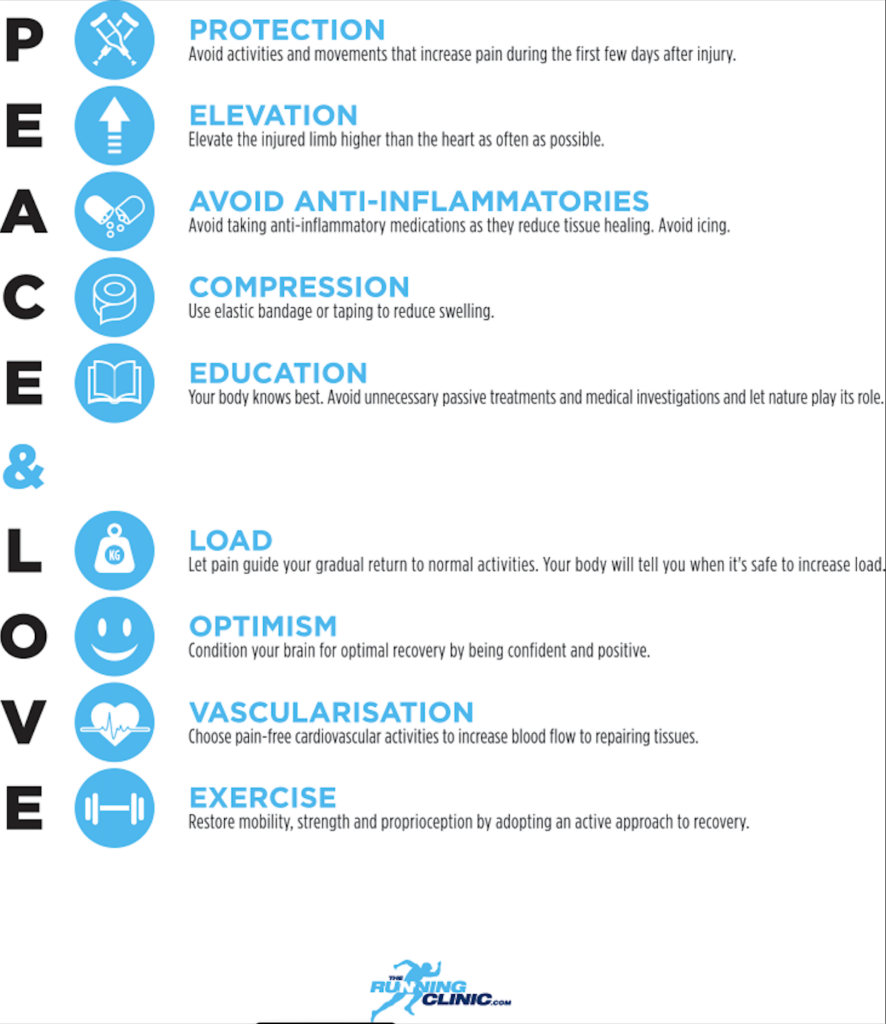
For the first one to three days, your body requires a little PEACE:
Protection. Restrict activities and movements that increase pain
Elevation. Elevate the injured limb higher than the heart to encourage collected fluid to drain
Avoid Anti-Inflammatories. Say no to ice and NSAIDs, and opt for Tylenol instead if needed
Compression. Use a soft elastic bandage to gently compress the affected area
Education. Ask your doctor to explain what’s happening in your body after an injury so you don’t overtreat or seek unnecessary interventions
After a few days have passed, LOVE comes into play:
Load. Apply load to the limb and resume your normal routine as soon as symptoms allow
Optimism. Prime yourself for smooth sailing by staying confident and positive
Vascularization. Do pain-free aerobic activities to increase blood flow
Exercise. Adopt an active recovery approach to restore mobility, strength, and proprioception
The acronyms may not be as easy to memorize as RICE, but the main takeaway is that there’s value in allowing the inflammation response to occur and embracing an active approach to recovery.
And having a positive mindset, as indicated by the “O” for optimism, is as applicable here as it is in other areas of life “We’re learning more and more about the strong mental component that can go into injury and recovery, and how maintaining an optimistic attitude and avoiding this catastrophization of an injury is actually helpful for recovery,” said Luther.
Remember, consulting a doctor is always best practice to rule out a serious tear or fracture, and a physical therapist may be able to aid you in working out a custom treatment plan.