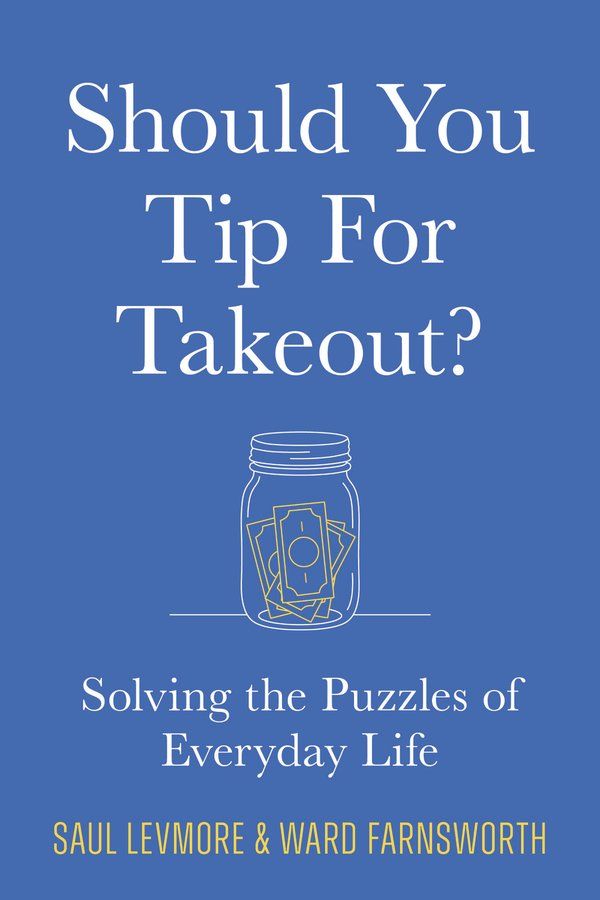
Saul Levmore and Ward Farnsworth are college professors, so it’s fitting that the title of their new book is a question rather than an answer (beyond that being a fair way to pique interest). Like all good teachers, the authors don’t just want us to learn — they want us to learn how to think.
In Should You Tip for Takeout?, they mine the fields of law, economics, philosophy, sports, and rhetoric to present a “tool kit for a more rational life.” Far from being an etiquette guide, it’s instead an invitation to expand the way we look at the world, so we can better understand not only our own behavior but others’ as well.
Each chapter uses a common quandary — like whether you should recline your airplane seat or get a second opinion before surgery — as a jumping-off point to introduce heuristics and critical thinking techniques that can be applied to countless other scenarios. The resulting pages offer up food for thought and fodder for lighthearted debates.
“One way to think about it is we’re trying to write a book that helps people have more fun having conversations at the dinner table,” Farnsworth explained in an interview with Nice News, noting that discussions these days seem to so easily devolve into political arguments or fear-based speculations about the future.
“We thought, ‘You know, there’s a lot of things just in everyday life that are actually pretty interesting to think about if you look more closely at them than most people usually do,’” he said, adding: “What would it mean to really take this one apart rationally? What can you learn about the problem that makes everyday life a little more interesting, and maybe what can you learn about rationality that makes other things easier to understand?”
Again, anyone hoping for simple “yes” or “no” solutions to life’s dilemmas would be opening the wrong book. In a chapter called “Should You Keep Looking for a Better Price?,” for example, the authors encourage readers to acquaint themselves with distribution patterns and standard deviations.
In another, they demonstrate how one might use the mathematical theory of optimal stopping to choose a romantic partner. (Essentially: View the first 37% of your dates or relationships as a comparison pool, and then pick the first subsequent person who’s better than the best one in the sample cohort.)

Saul Levmore
That’s not to say there are no straightforward answers. The title chapter delves into the power we have with our wallets to vote for or against a custom when it hasn’t yet become a norm. If something has become entrenched, it’s likely in our best interest to go along with it, whether or not we agree. In the case of tipping for takeout, the authors say that the verdict is in: It’s the norm, so you should tip what you deem a reasonable amount. And doing so may not matter as much to your pocket as you might imagine.
“Think of it as a hidden price hike,” Farnsworth said. “But the good news is that you have something to say about it. You have some discretion on how much you’re going to let that price go up. And that should be considered a welcome thing rather than a bad thing, because the alternative is the price goes up for everybody.”
The authors said that simply musing through these kinds of common scenarios can reveal possibilities one may never have considered for why things are the way they are and what alternatives exist.

Ward Farnsworth
“One broad takeaway to me is that people should experiment more in their own lives,” Levmore said, adding, “I think the book tries to encourage people to imagine how the world could be a little bit different from the way it is.”
It may also help expand our empathy, Farnsworth pointed out. “Sometimes looking at life and looking for the rationality in it is a way to be more generous-minded toward other people who appear to just be annoying you at random and may be doing just what you would do if you were in their shoes.”
When our conversation turned to the most favorable order in which to be interviewed for a job, the pair demonstrated — perhaps unintentionally — just how the aforementioned dinner table discourse may go. “I think it’s a disadvantage to be the last person,” Levmore said, prompting Farnsworth to disagree: “I generally think you want to go last. You want to go as late as you can.”
“They get tired,” Levmore rejoined after Farnsworth elaborated, to which Farnsworth replied, “Maybe,” then added: “There’s no right answer to these questions. We just think these problems that most of us sort of wander through unconsciously, they’re just more interesting when you slow down and really ask, ‘What is the best way to handle this?’”