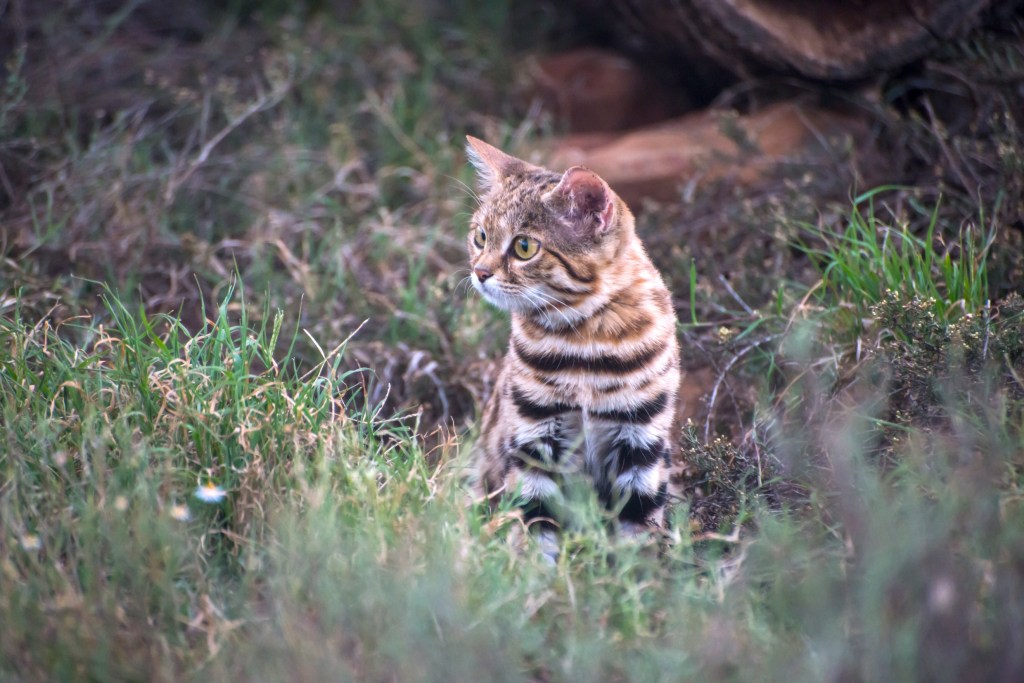
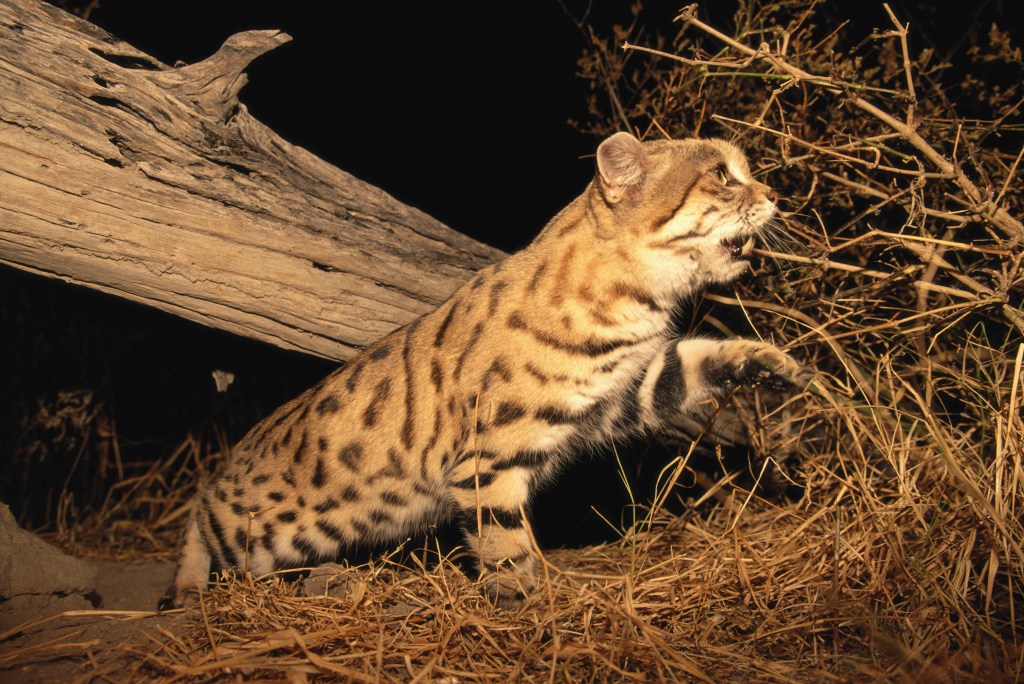
If you were a gerbil or a small bird in the deserts of southern Africa, you’d likely spend your nocturnal hours fearing the African black-footed cat — or the Felis nigripes, if we’re being technical — a vicious killer with night vision and incredible hearing abilities, capable of targeting its prey with exceptional accuracy. But as a human, you’d be forgiven for wanting to snuggle up to this miniature menace (after all, people aren’t on its menu).
It turns out that the world’s deadliest cat might also be in the running for the cutest, with its tiny stature, round face, and curious eyes. Make no mistake, though: Despite weighing between just 2 and 6 pounds (less than most housecats), this is no passive pussycat.
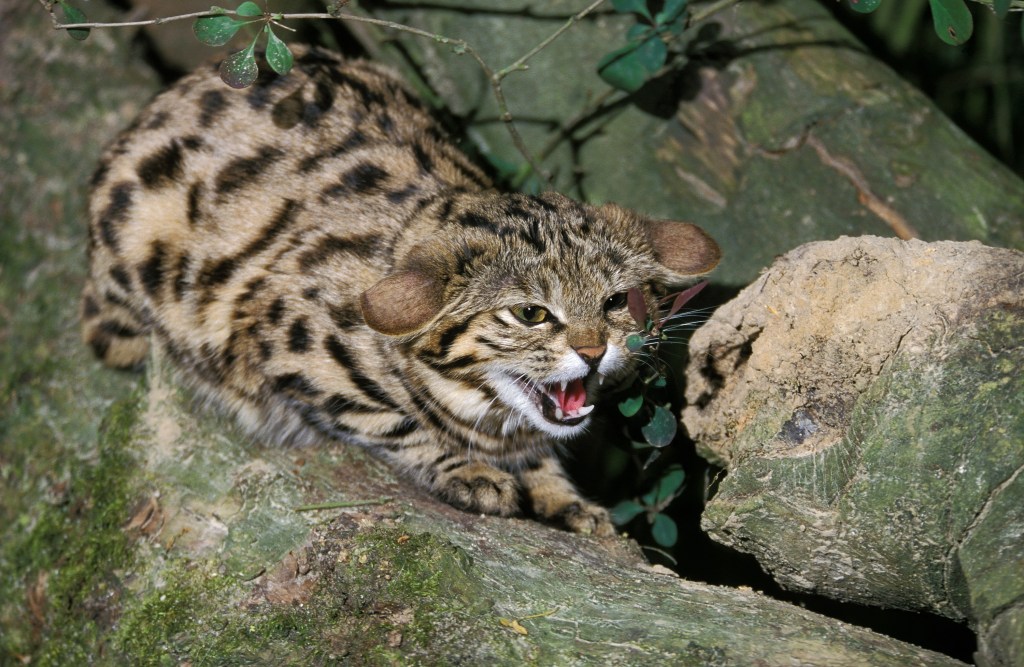
African black-footed cats have a hunting accuracy of around 60% — up to three times higher than their more sizable and well-known continental cousins like lions and cheetahs, per Live Science. In fact, this cat is Africa’s smallest, measuring up to 20 inches long and 8 inches tall. As the International Society for Endangered Cats, or ISEC, points out, their big heads, eyes, and ears aren’t just adorable; they’re also adaptations that allow them to hunt in the dark, detect the sounds of even the quietest prey, and survive the desert’s unforgiving heat. Their namesake black paws are equally advantageous, enabling them to walk on the sun-scorched continent’s hot sand.
Black-footed cats can jump nearly five feet in the air to intercept birds fleeing a potentially grisly fate, and spend their dark hours in constant search of prey — they make between 10 and 14 kills a night, averaging a savage snare every 50 minutes. Researchers have seen them engaging in various hunting techniques, from leaping randomly through tall grass to sitting silently at the entrance of a rodent’s burrow, waiting as long as two hours to strike.
These wild cats may not be taking down antelopes or gazelles, but their fierce dispositions render them forces to be reckoned with in Africa’s arid shrublands — they’ve even been observed defending themselves against the much larger jackal, according to ISEC. They primarily eat rodents and can consume up to 3,000 of them a year. While living in the desert makes water resources more scarce, this food source contains enough moisture to satisfy the black-footed cat’s hydration needs, meaning they don’t need to drink freestanding water.
As mentioned earlier, nighttime is when the cats earn the title of world’s deadliest, spending their days sheltered from the blistering heat and resting in the empty burrows of rodents like springhares and aardvarks, per ISEC. They also hang out in abandoned termite mounds, a habit that’s prompted the nickname “anthill tiger.” And like most wild cats, their lives are generally solitary, except for when they’re mating and rearing a new generation of killer kittens.
Due to their size and small population, they’re among the least-studied animals in Africa, and fewer than 10,000 mature individuals are believed to exist in the wild. Unfortunately, that number is becoming even smaller according to the IUCN’s Red List, which lists the Felis nigripesas “vulnerable” — research reveals that the cats’ prey base is declining due to bushmeat poaching and the loss of their habitat from overgrazing. Black-footed cats also fall victim to road collisions, domestic dogs, and jackals, the latter of which are becoming overabundant.
Nevertheless, we can still enjoy gazing at their doe-eyed faces and imagine them leaping and bounding through desert grasses like excited housecats.
RELATED: 72 New Wildlife Species Were Identified by Cal Academy of Sciences in 2025