
This article was originally written by Vanessa Mangru-Kumar for SWNS — the U.K.’s largest independent news agency, providing globally relevant original, verified, and engaging content to the world’s leading media outlets.
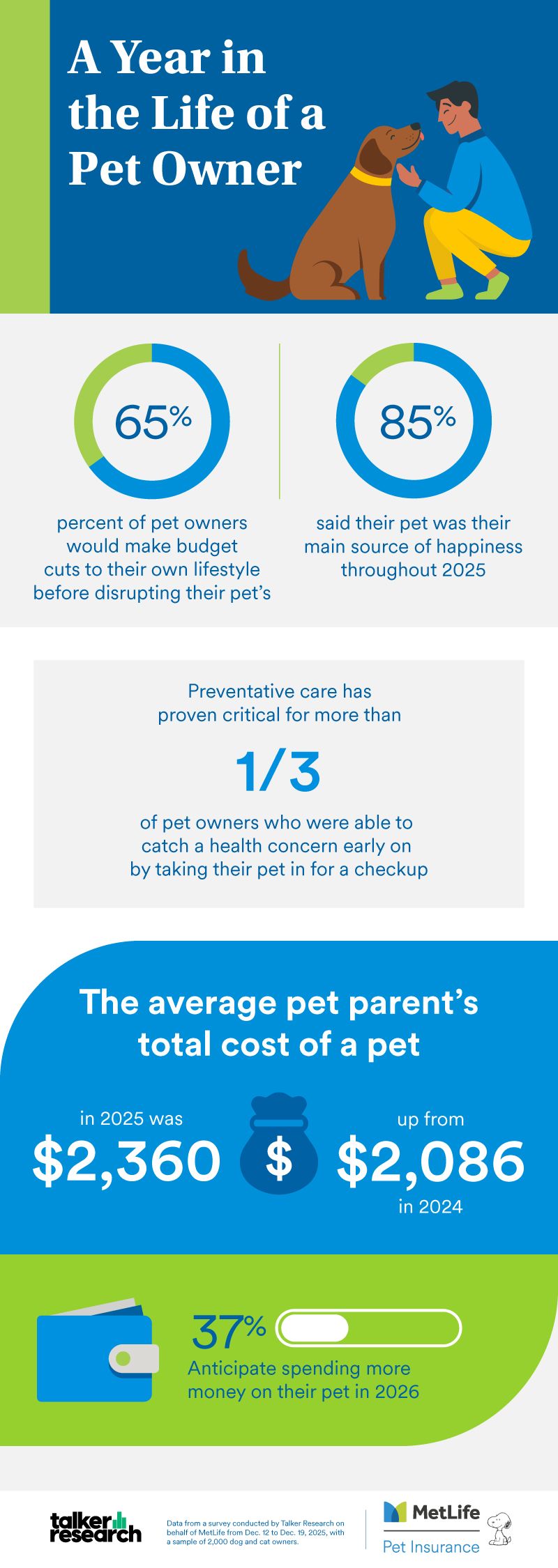
A look at the comments section of many an adorable dog or cat video will tell you that “there’s no such thing as spoiled” when it comes to pets — and some new stats are backing that up. In a survey of 2,000 pet owners, 65% said they’d make budget cuts to their own lifestyles before interfering with their furry friends.’
Conducted by Talker Research on behalf of MetLife Pet Insurance, the annual survey of U.S. dog and cat owners revealed that they spared no expense, splurging on high-quality food (66%), new toys (40%), and grooming sessions (24%). But you can’t put a price tag on love: 85% of respondents said their pet was their main source of happiness throughout 2025.
Thinking back on the year, pet parents recalled their companions being around through tough times like financial struggles (31%), mental health challenges (30%), and losing a loved one (24%). And 91% said their pet gives them something positive to focus on when things aren’t going their way.
Knowing how much their furry friends mean to them, 71% reported that even when they have other things on their mind, their pet’s future is constantly up there with their concerns.
To ensure their pet’s wellness over time, owners are most keen on staying up to date on vaccinations (48%) and purchasing high-quality food (46%) while others prioritize regular exercise (45%) and regular grooming (42%).
Consistent vet visits were key to staying on top of the animals’ health, with a majority of respondents saying their pet visits the doctor just as often as they do — if not more.
Most of these visits tend to be preventative care, while 40% are reactive, meaning they take them in when something is wrong. This care has proved critical for more than a third of owners, who said they were able to catch a health concern early on by taking their dog or cat in for a checkup.
“Preventative veterinary care can dramatically change health outcomes. These findings tell a clear story: regular checkups, vaccinations, and dental exams help keep small problems from becoming emergencies,” said Brian Jorgensen, CEO of MetLife Pet Insurance, who noted that the company offers guidance to help owners stay current with their pets’ care.
The survey also points to the rising costs of animal care: Respondents spent an average of $1,135 related to their pets’ health in 2025, with $472 on insurance and the remaining $663 on vet visits. That total is up from $998 in 2024, when those surveyed spent $348 on insurance and $650 on vet visits.
These increasing costs have led to more people creating dedicated pet budgets. In 2025, nearly half (48%) had a budget when it came to how much they aimed to spend on their pet, compared to 42% in 2024. And while 2024’s average monthly budget was $115, it increased to $138 last year.
Pet owners were able to save on food (down to $470 in 2025 from $506 in 2024) but reported increases in how much they spent on toys ($247, up from $198), clothes ($223, up from $150), and treats ($285, up from $234). This brought the average total cost to $2,360 in 2025 — up from $2,086 in 2024.
And with the state of the economy, 37% anticipate spending even more money in 2026 — an expectation that pet owners have had since 2024 (36%). To that end, the participants were trying their best to plan ahead, especially as more than 1 in 5 had a pet undergo a major unexpected health event in 2025 (22%), nearly double the percentage from 2024 (13%).
While more respondents said they were prepared for the cost this time around, the bill still averaged a hefty $555.
“Pet emergencies are unpredictable and expensive. It’s encouraging that 71% of pet parents now feel financially prepared for a medical emergency, up from 52% in 2024, but nearly a quarter still aren’t confident,” said Jorgensen. “Families can take practical steps to strengthen their safety net: Talk with their veterinarian about potential costs and consider pet insurance to help manage their expenses and surprise bills. Preparing now means pet owners can take action quickly when it matters most, focusing on their pet’s care, not their wallet.”
RELATED: Say Hello to the 3 Latest Dog Breeds Recognized by the American Kennel Club