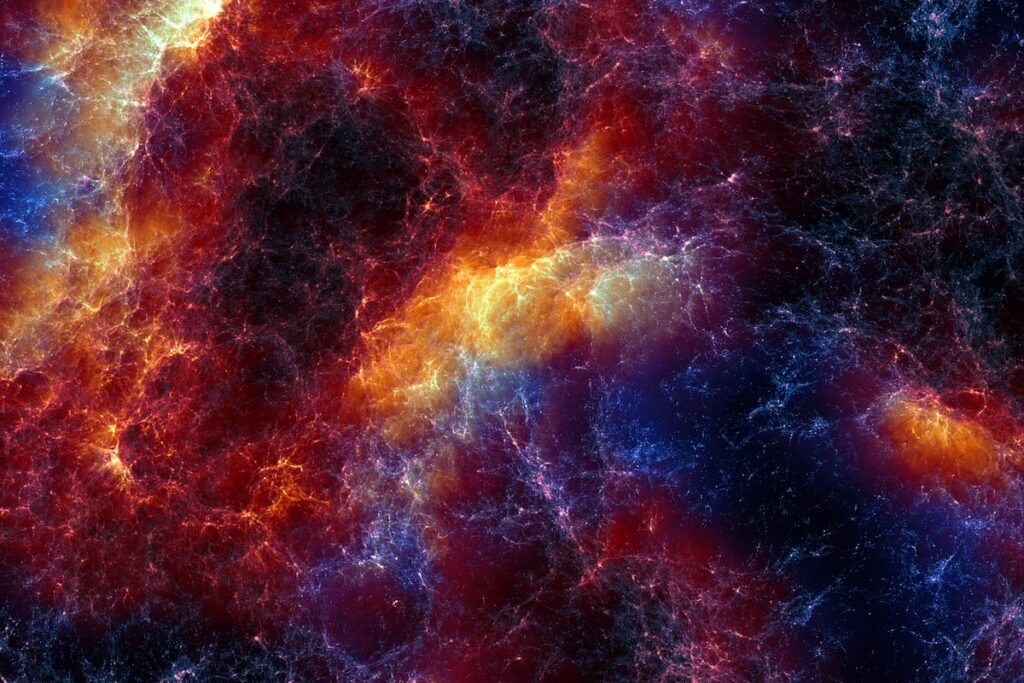
What happened after the Big Bang? A team of physicists, harnessing the James Webb and Nancy Grace Roman space telescopes, are working to visualize the answer to that question using a novel computer simulation called Lumina. And they’re sharing some pretty stellar images and videos in the process.
A new study out of the Harvard and Smithsonian Center for Astrophysics introduces Lumina, which provides an unprecedented look at how the universe may have formed. The simulation harkens back to the nascent universe, from the dark ages that followed the Big Bang through the next 2 billion years of cosmic evolution.
“The early universe has become an exciting new frontier in astrophysics,” lead author Oliver Zier said in a statement, crediting the James Webb scope. “To understand what we are seeing with this telescope, we need to translate our theories into detailed predictions. After several years of work, with plenty of ups and downs, it is incredibly rewarding to see the simulation results and watch our predictions come to life in video.”
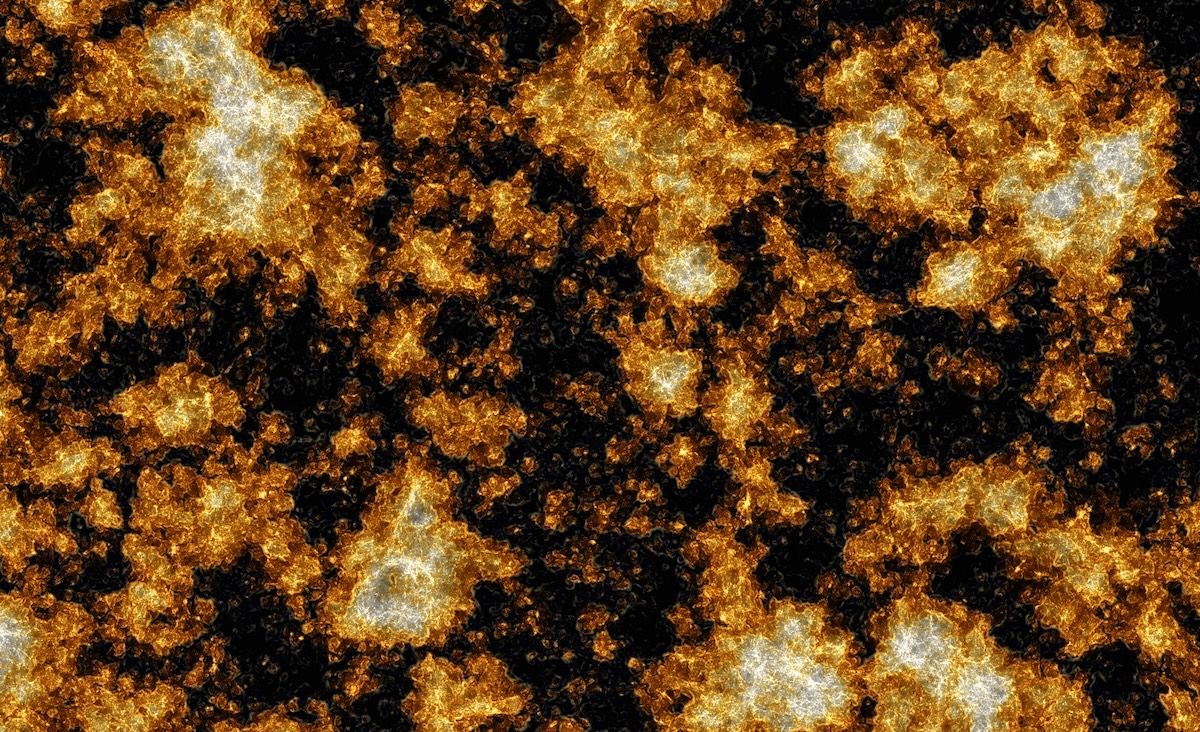
A visualization of hydrogen re-ionization
Those predictions focus on how the first galaxies, stars, and other cosmic structures were able to form amid a period of total darkness. Per a press release from MIT, the effect of the Big Bang was such that no light or radiation could pass through the “shroud” of neutral hydrogen created by the rapid expansion event. Eventually, however, two massive transformations occurred: the re-ionization of hydrogen and the re-ionization of helium.
Hydrogen re-ionization refers to the era when the first stars were able to emit enough ultraviolet light to strip the neutral hydrogen of its electrons, preventing it from absorbing photons and thus “allowing light to travel freely.” Similarly, helium re-ionization refers to the breaking apart of neutral helium via high-energy light, something thought to have been fueled by supermassive black holes. The simulation captures these two essential processes in detail for the first time.
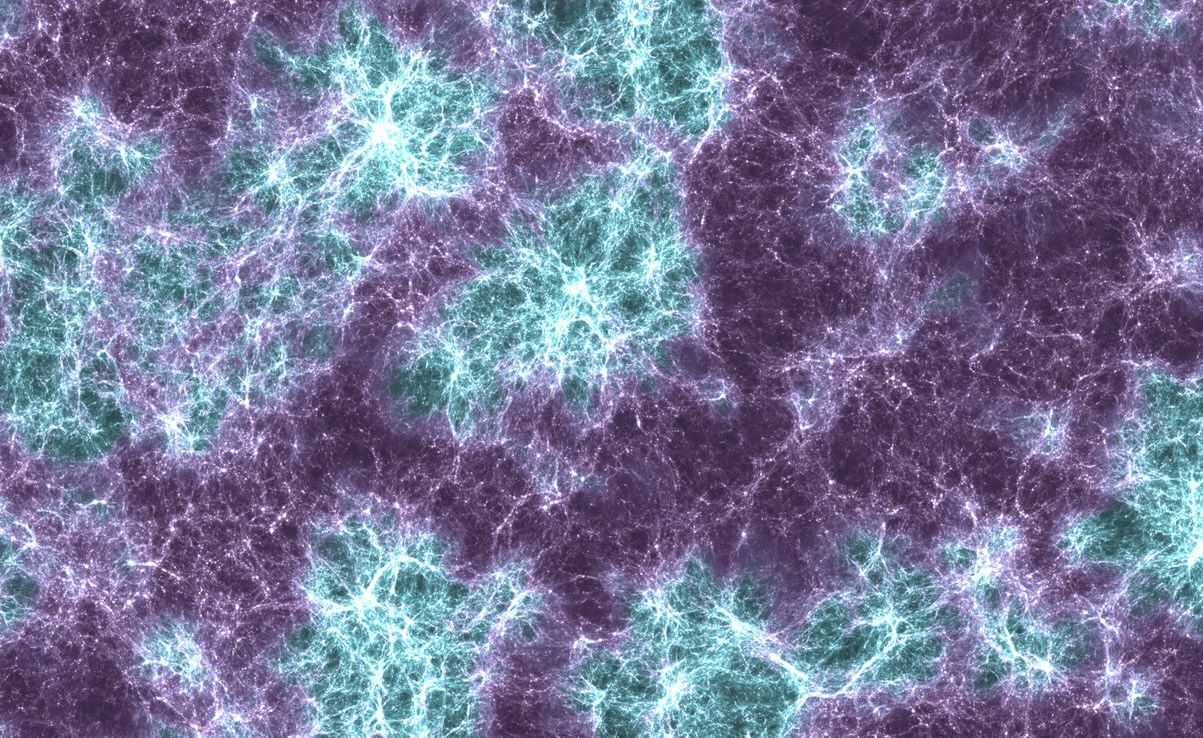
A visualization of helium re-ionization
“Lumina does everything from small-scale star and galaxy formation to large-scale re-ionization of hydrogen and helium, in a volume that is 100 times larger than previous best simulations,” study co-author Mark Vogelsberger said in the press release. He added the detail is unparalleled: “Other simulations cannot zoom in as far as this. The difference between the smallest and largest scales that we simulate is larger than in any other simulation.”
Looking ahead, the team is making Lumina available to the scientific community to compare its simulations with real-world snapshots taken by new and future telescopes and tell a more complete story of how the first galaxies, stars, and structures of the universe may have formed.
RELATED: Good Morning From Mars: NASA Rover Gives Unprecedented Look at Martian Dawn