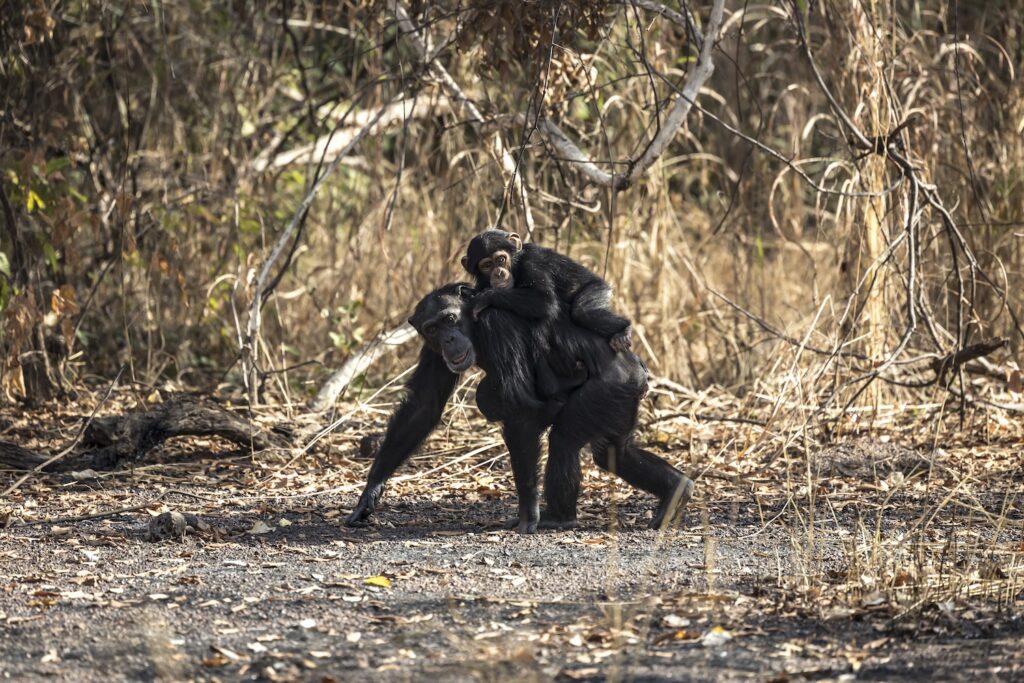
In a nature reserve in Senegal, a life lesson unfolded: A mother chimp named Soukki poked a stick into an ant nest, then pulled her daughter, Saïsaï, over to see it. Saïsaï then drew the stick out of the nest and snacked on the ants.
It’s one of many interactions documented in a study published this month that suggests adult chimps hand down their savvy tool-use skills to youngsters by showing them what to do — quite similar to how humans often teach little ones by example.
“This study demonstrates that chimpanzees teach tool use to younger individuals, expanding our understanding of the learning strategies of our closest relatives,” lead author Andreu Sánchez-Megías, with the Jane Goodall Institute Spain, said in a statement. He added that acts of transferring tools, like in the case of Soukki and Saïsaï, seem to be a form of teaching, employed alongside demonstration and supervised practice.
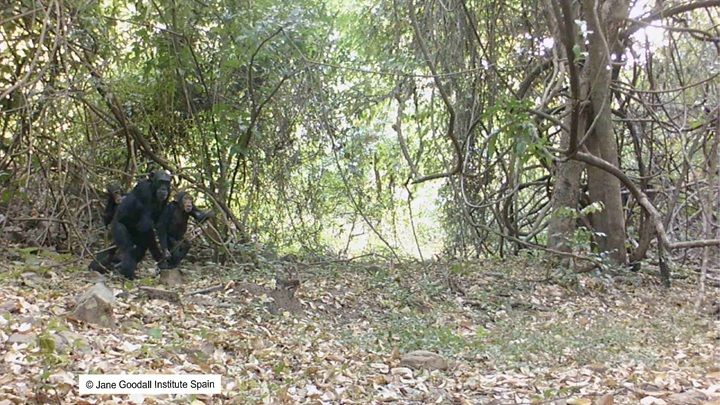
Jane Goodall Institute Spain
The findings come after researchers analyzed eight years of footage from wildlife cameras installed at more than a dozen locations in the Dindefelo Community Nature Reserve. They documented 33 total instances of instruction-like tool transfer between chimps, most of which involved adults (often mothers) showing youngsters (often infants) how to use sticks to fish for ants and algae.
In some cases, however, it was the younger generation leading the learning. In about 12% of instances, juveniles were the ones transferring tools to adults, and in 9%, infants transferred them to juveniles.
Previous studies have documented chimpanzee tool-transfering behavior, but the new paper “expands our knowledge on the facilitation of infant learning by experienced individuals, especially mothers, and raises questions regarding the role of juveniles as models, as well as the effect of being instructed by individuals with various skill levels,” the authors wrote.
Next to humans, chimps have been found to possess the most diverse collection of technological behaviors in the entire animal kingdom. Documentation of these behaviors first dates back to 1960, when Jane Goodall famously observed a chimp she’d dubbed David Greybeard using a stick to extract termites from a mound in Tanzania’s Gombe Stream National Park.
The late primatologist revolutionized her field, setting the stage for the research being conducted today. At the time, her mentor, paleoanthropologist Louis Seymour Bazett Leakey, was said to have told her, “Now we must redefine ‘tool,’ redefine ‘man,’ or accept chimpanzees as human.”