Self-improvement strategies abound, so opting in to one can sometimes feel like ordering the soup du jour: “That sounds good. Maybe I’ll try it!” But what’s right for one person may not be right for another — or even for the same person at a different point in time. That’s why Tchiki Davis, founder of the Berkeley Well-Being Institute, suggests aligning the methods we use to prioritize our mental health with the life stage we’re currently in.
Davis subscribed to this concept only after spending more than a decade investigating the best ways to improve well-being. In all that time, she’d come up with relatively little that could apply as a blanket measure for all people. It wasn’t until she happened upon a used book detailing models of development and began looking into the research behind them that she had an epiphany.
“Suddenly it all made sense why certain psychological strategies don’t work for everybody — because they aren’t at the developmental stage where it even makes sense to use them,” Davis, who holds a doctorate in social and personality psychology from the University of California, Berkeley, explained to Nice News.
Davis describes her insights in a workbook called The Path to Well-Being, which includes practical exercises for each life stage (she offers the digital version for free online, and paperback copies are available on Amazon). She’s also developed a training course based on the material that’s geared toward mental health professionals. We spoke to the author about her ideas and how you can implement them to boost your own well-being.
The 8 Stages of Development
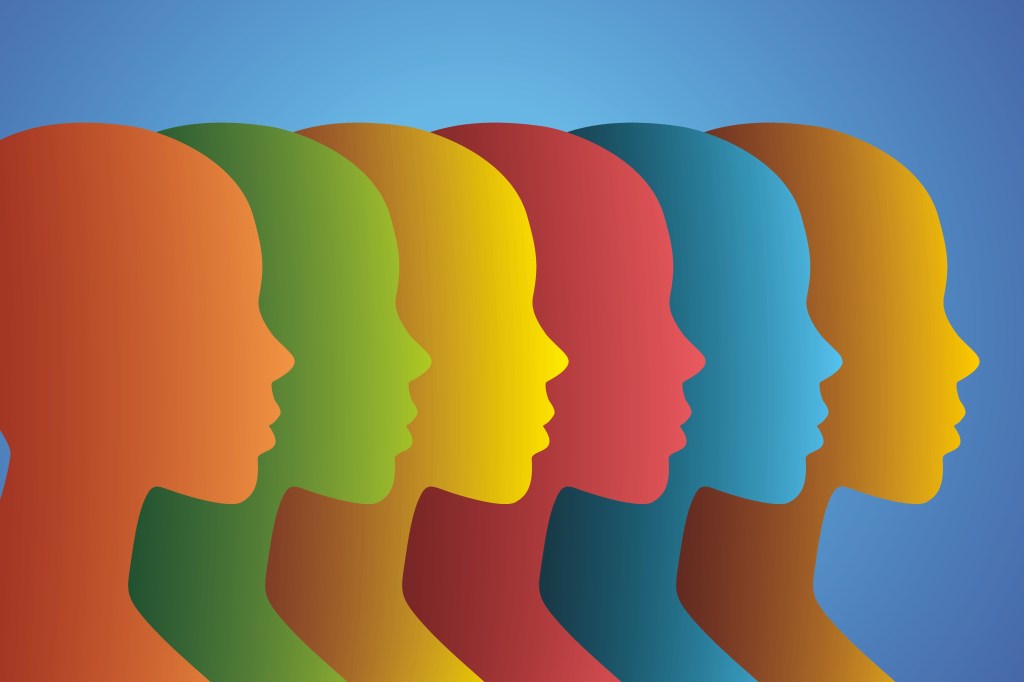
Drawing on the work of Susanne Cook-Greuter, Ken Wilber, and others, Davis delineates eight stages of development, corresponding them to the colors of the rainbow for ease of understanding. They’re described in detail in The Path to Well-Being, but here’s a brief description, excerpted from the workbook:
Red Stage: We focus on the body (self-centric)
Orange Stage: We focus on social interactions (peer group-centric)
Yellow Stage: We focus on behaviors or skills (skill-centric)
Green Stage: We focus on emotions or outcomes (outcome-centric)
Teal Stage: We focus on thoughts or perspectives (understanding-centric)
Blue Stage: We focus on beliefs or patterns (pattern-centric)
Indigo Stage: We focus on concepts or constructs (construct-centric)
Violet Stage: We focus on awareness or unity (oneness-centric)
Per Davis, research has shown that to boost our well-being, we need to focus on building psychological skills for the stage we’re primarily in, and to grow personally, we need to build skills that are a step or two ahead of where we presently are.
What Stage — or Stages — Are You in?

Davis explains in the book that we can think of the developmental stages like the rings of a tree. Rather than moving linearly through each one, we collect them, broadening the lens through which we look at life as we go. “It’s not like the stages are separate,” Davis said. “So maybe you see things from a broader lens in one area of your life, like your work, but not in your relationship.”
The stages also aren’t chronological — though the first two are often moved through in our earlier years. The vast majority of us transition from red stage to orange stage as kids, but turning 85, for instance, does not automatically shift us into indigo.
To help readers identify which stage or stages they’re in, Davis includes writing prompts that encourage reflecting on the various aspects of self. If you’re evaluating whether you’re mainly in orange stage, you may consider how frequently you display behaviors like people-pleasing and validation-seeking. If you’re wondering whether you’re in blue stage, you might think about how often your emotions are influenced by identifying and breaking personal or societal patterns.
Another way to identify your stage is to take stock of your current goals. “The way that I think has been the most effective for me personally is looking first at the person’s goals, their outcomes that they’re interested in, because those shift,” Davis explained. “Somebody at green stage is very achievement-oriented — it’s like, ‘Oh, I want to do this thing and have this outcome.’ And then they switch to the next stage, and it’s more about the process, the journey. So at each stage, what you value changes.”
Most American adults are in yellow or green stage, Davis writes, while only a tiny fraction of us (around 0.5%) have reached violet, the stage in which we feel at one with the world and everything in it.
3 Example Exercises
As noted, The Path to Well-Being includes specific exercises for each stage, but as the majority of adults will have transitioned out of red and orange, yet aren’t through to blue, indigo, or violet, we’ll share one exercise each for yellow, green, and teal.
That said, as you peruse the workbook, it may be helpful to do some of the earlier practices — like the simple breathing and five senses exercises in the red stage chapter — to brush up on foundations or help with specific areas of your life.

Yellow
Around 37% of adults are in yellow stage. In this stage, we realize that we’re more than how people view us, that we’re in control of our lives, and that changing our behavior results in changing our experiences.
Self-Compassion Letter: To begin this exercise, first reflect on something that makes you feel bad about yourself, or less than. It could be connected to your personality, your relationships, your career, or any other aspect of your life. Then, write a compassionate letter to yourself. You might remind yourself that other people also have weaknesses as well as strengths, and may even be struggling with the same thing you are. Finally, consider if there are any steps you can take to improve yourself in this regard, focusing on positive actions that might make you feel better.
Green
In green stage, “we see that our actions, skills, and knowledge don’t really matter
unless they lead to the outcomes that we desire,” Davis writes, noting that research indicates 30% of adults are in this phase of development.
Vision Board for Self-Improvement: This is a fun one! Vision boards act as visual representations of our goals and aspirations. First, consider what areas of life you’d like to improve — e.g., physical or mental health, relationships, finances, career — and then set specific goals (like gaining muscle mass or spending more quality time with friends). Next, look for words and images you can cut out or print that represent these goals. Create a poster-size collage and place it somewhere you can see, and reflect on it regularly.
Teal
Teal stage, which about 11% of adults are in, is when we start to realize and accept that we’re more than our achievements. Boosting well-being in this stage involves exploring ourselves and the world from a variety of perspectives.
Forgiveness and Misunderstandings Exercise: Think about a disagreement or misunderstanding that shows up repeatedly for you — whether it’s an argument you have over and over with your partner or an interaction that’s occurred multiple times at work. Describe it in detail. Once you’ve done that, make a plan that the next time it happens, you’ll focus more on understanding the other person’s perspective than making your own position understood. To do this, write down a few questions you’ll need to ask that person so that you can fully understand their point of view.
Click here to learn more about The Path to Well-Being and download it for free.
When you buy books through our links, Nice News may earn a commission, which helps keep our content free.