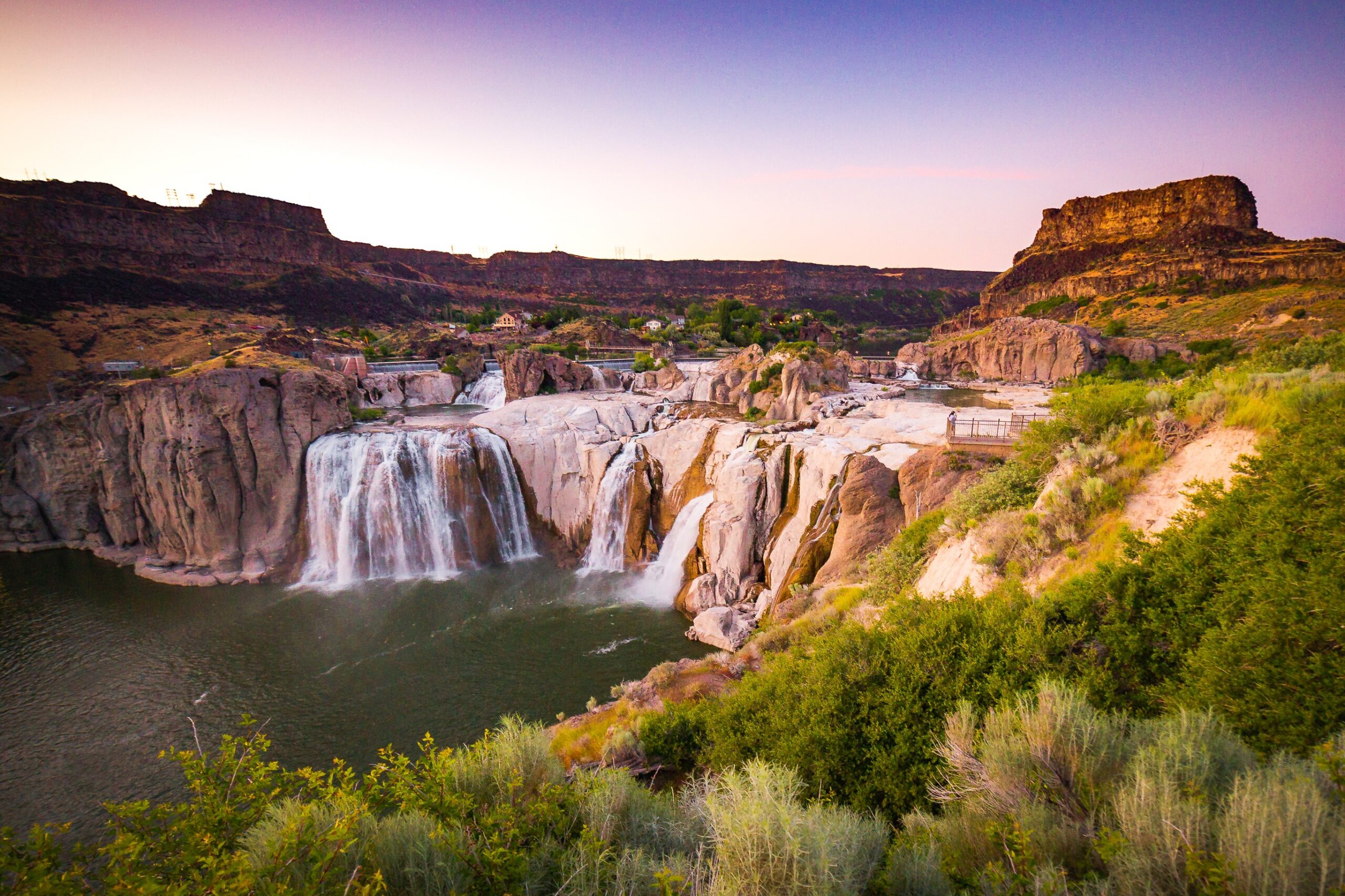
If you’ve made the trek to western New York, donned your obligatory yellow or blue poncho, and witnessed the sheer enormity of Niagara Falls, you may think you’ve seen it all when it comes to impressive waterfalls in the U.S. But allow us to introduce you to another, equally majestic yet lesser-known natural phenomenon that’s worth a spot on your bucket list: southern Idaho’s Shoshone Falls, dubbed the “Niagara of the West.”
Niagara beats Shoshone when it comes to volume — 6 million cubic feet of water tumble down the border-straddling behemoth every minute during peak daytime hours — but at 212 feet, the Idaho attraction is the taller of the two. The horseshoe-shaped falls, situated at the edge of Twin Falls on the Snake River, are over 900 feet wide and among the largest in the country.

But it wasn’t always a landmark destination. Archaeologists believe the falls were formed when Lake Bonneville, a prehistoric lake that encompassed part of Idaho, flooded over 14,000 years ago. According to Intermountain Histories, however, the Native American Shoshone-Bannock tribes that the falls are named after tell a different origin story: Legend goes that after a coyote named Ejuba failed to build dams multiple times, various waterfalls formed as a result, the biggest of which is Shoshone.
The spot provided a wealth of salmon for the Shoshone people, as the falls’ height barred the fish from swimming farther downriver. The University of Idaho Library noted that in 1843, a U.S. explorer wrote in his journal after observing the Native Americans: “When the salmon came up the river in the spring, they are so abundant that they merely throw in their spears at random, certain of bringing out fish.”

Two decades later, gold was discovered in the area in 1869, drawing a horde of miners, and in 1883, tourists were given access with the completion of the Oregon Short Line Railroad in southern Idaho. In 1905, the United States Geological Survey officially recognized the falls’ current name, and development for hydroelectric use began shortly after.
Because of these changes, as well as modern irrigation diversion of the Snake River, you may not be able to witness the full extent of the falls’ plunging waters year-round, but they’re still absolutely worth a visit. The best time to explore them is now — more specifically, from March to early May, when winter snowmelt can push water volume past 20,000 cubic feet per second, according to Southern Idaho Tourism.
And unlike Niagara Falls, which travel bloggers Jeff and Crystal noted can feel “overshadowed by commercial development,” Shoshone’s visitors often feel more immersed in nature. “It almost feels like you are leaving town to get to the falls,” they added. “This has allowed the splendor of the attraction to be the only distraction.” They’re light on the wallet, too: Hundreds of thousands of visitors each year pay just $5 per car to enter Shoshone Falls Park.
The park provides opportunities for hiking, picnicking, and swimming — and adventurous travelers can kayak to the base of the falls, as well as zip-line or partake in BASE jumping across Snake River Canyon. And if you’re lucky, you might just catch Shoshone when its flow rates are intentionally increased. Last June, for example, they were ramped up to help young steelhead and chinook salmon flow down the Snake River to the ocean.

“Honestly, it’s kind of indescribable,” Cole Yoder, who lives in Meridian, Idaho, told Idaho News 6 at the time. “It’s incredible in every magnitude and in every way.”
If you can’t make it to Shoshone Falls quite yet or just want a preview of the spectacle, check out this video to get a splash of the action.