In the second half of Stanley Kubrick’s The Shining, there’s an iconic sequence that’s arguably as terrifying as Jack Nicholson’s ax-wielding rampage.
It begins quietly, the camera following Shelley Duvall as she walks toward a shadowy room. Her footsteps echo in the silence before an ominous sound creeps in, almost like distorted white noise. The music builds, getting louder and more complex as warped high notes slowly penetrate the din. It’s chaotic, dissonant, deafening, mirroring the emotions on Duvall’s face, until finally, finally — well, we won’t give you any spoilers.
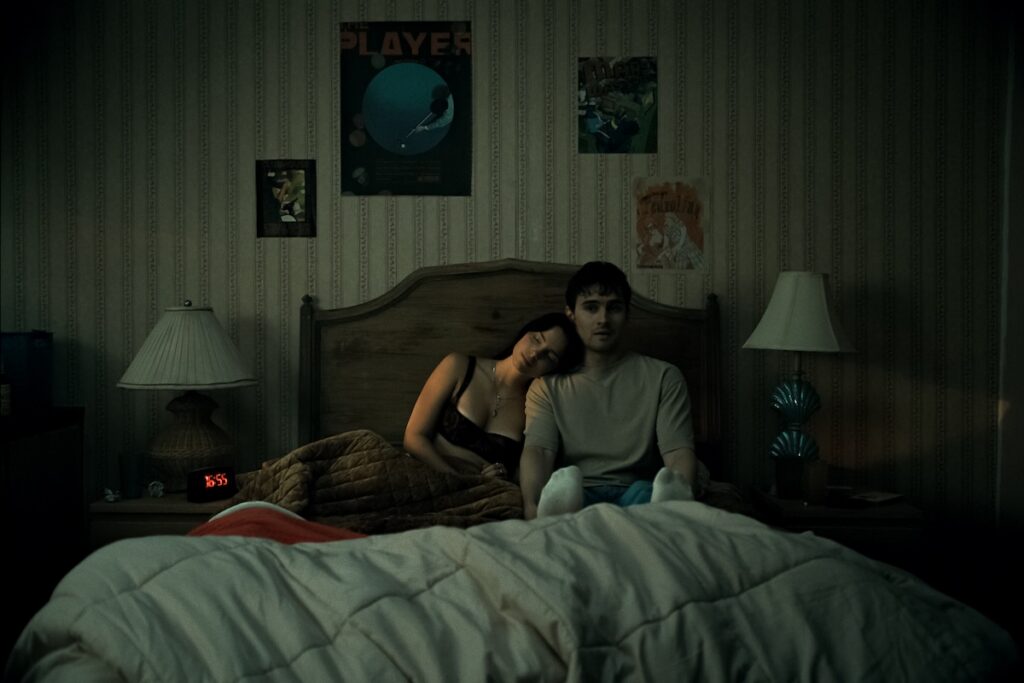
“If you watched it on mute, I don’t know if it would feel nearly as scary,” Rock Burwell told Nice News of the classic flick. Burwell composed the score for this year’s breakout indie horror film, Obsession, which raked in $500 million-plus off a $750,000 budget, making it the highest-grossing movie ever produced for under $1 million.
The Los Angeles-based composer recognizes how essential music is to evoking emotion in filmgoers, and his eerie orchestration played an outsize role in Obsession’s success. “What just generally has always drawn me to music in the first place is its ability to influence how we feel,” he said.
But what exactly makes scary music scary? We may all have some general idea of the characteristics of creepy music — the crescendo of staccato strings in Psycho’s shower scene comes to mind — but the way in which a score achieves its effect varies greatly. There are certain common elements, however, that lend themselves to disconcerting an audience.
Subverting Expectations
For Obsession, Burwell — after discussions with writer-director Curry Barker — chose a nontraditional approach, opting to subtly discomfit viewers through dreamy, nostalgic melodies, slightly pitch-bending his notes and drenching everything in reverb.
“It was fun to explore not coming in with these really harsh, interval, screechy-sounding kind of things that you hear in a lot of horror movies,” he explained, “but actually coming from something that feels a bit more warm and almost comforting. But the way it moves and is undulating underneath is very — it kind of gets under your skin a little bit more.”
Composer Katy Jarzebowski, who recently scored the award-winning documentary Gaslit featuring Jane Fonda, has been working in the industry for over 20 years. She noted that today’s savvy audiences are well-versed in the language of film. The key to unsettling them, then, is to present a musical choice they don’t necessarily understand or expect.
“If you give them something that they know and love, then it kind of takes that feeling of discomfort away,” she explained, adding: “[When filmmakers] don’t give them something that they expect, it becomes uncomfortable.”
Tension
Tension is the heart of any horror film, and a good one typically leaves viewers on tenterhooks throughout. To that end, Burwell noted that the descending melodies and drawn-out cues he used can cause audiences to feel as though they’re suspended, waiting for a resolution that never comes. “Everything is very, like, ambient and long, and it’s slow moving,” he said. “I think that the pace of it really allows those feelings to sit in a bit longer.”
He added that he’s heard from fans that the sweet-yet-tainted score had them feeling “very comforted, but at the same time, feeling kind of bad or that there’s something missing or that there’s yearning.”
Jarzebowski agreed with the idea of holding out on viewers. “It’s a lot about where you choose to come in or where you choose to hold back,” she said. “You know, a lot of times [it’s] not giving that kind of pillow for the audience to land on to remind them that they’re in a movie in the first place.”
In the Studio
Pete Horner is an Emmy-winning sound designer and re-recording mixer at Skywalker Sound (who also happens to be married to Jarzebowski). He pointed out that the terror conveyed through a horror movie’s sound isn’t merely from the music itself. Foley is the art of creating sound effects in a studio — things like footsteps or a door creaking — and Horner said it can be used to great effect for inducing fear in quiet scenes.
“By accentuating those things, it kind of draws you closer to the action, and it makes you feel uncomfortable because you shouldn’t be able to hear that,” he explained, adding: “It mimics what happens when you are scared, which is that you become hyperaware of your surroundings. And when you’re not scared, you probably don’t hear the footsteps at all, even though they are happening in the space you’re in. But if you are scared, every little tiny sound has huge meaning.”
Additionally, gradually removing the ambient background noise (called “room tone”) from a scene can be extremely disconcerting. “It’s something you want to use sparingly in a movie, but if you pull out of all of the ambiences, the effect that it has is the audience will hold their breath,” Horner said. “Because they’re listening, they’re trying to hear into the sound, and there’s nothing there. And it’s a very scary feeling.”
Working With the Cinematography
It’s typical for musicians to score to picture, meaning they create the music as they watch the film. But sometimes, the two arts inform each other more equally. In Obsession, Burwell sent early cues to Barker while he and director of photography Taylor Clemons were coming up with the shot list. Barker later told Burwell that playing the music on set really helped establish the mood they were going for. Likewise, watching Clemons’ claustrophobic cinematography influenced Burwell’s choices for the score.
“We kind of leaned on the darkness, like, there’s not much high frequency information in the music, and there’s not a whole lot of light in a lot of these scenes, too,” Burwell said. “I’ve kind of referred to it as a lot of the score feeling like a lead blanket or something like that. Like, it’s just really heavy. And I think the cinematography really informed that for me.”
Experimentation
Starting with what’s considered the first-ever horror flick (a three-minute silent French film from 1896 titled The Haunted Castle) to the dozens coming out in 2027, the genre is a confirmed favorite of moviegoers.
Call it sublimation or call it masochism, but people like to be scared. And that means composers have ample opportunity — and one could say the imperative — to get creative.
“Horror is a great place for composers, especially to experiment with different things because a lot of times, you’re trying to create a fear that someone doesn’t know yet,” Jarzebowski said, adding: “We already have Psycho, we have Stranger Things, we have [horror filmmaker and composer John] Carpenter — all this horror language that we’ve created. So you already know what to be scared of. So there’s always room for, like, ‘OK, what else can we do to make it even scarier? What haven’t they heard yet?’”