There’s no best tearjerker category at the Academy Awards, but this year’s winner would be a no-brainer if there were: Hamnet. Chloé Zhao’s adaptation of the novel by Maggie O’Farrell contends that the death of William Shakespeare’s son Hamnet inspired Hamlet, the Bard’s magnum opus (in addition to the play premiering just a few years after the 11-year-old’s untimely passing, the two names were interchangeable at the time). Historians are mostly unconvinced by the theory, but audiences have more than embraced the story’s emotional truth.
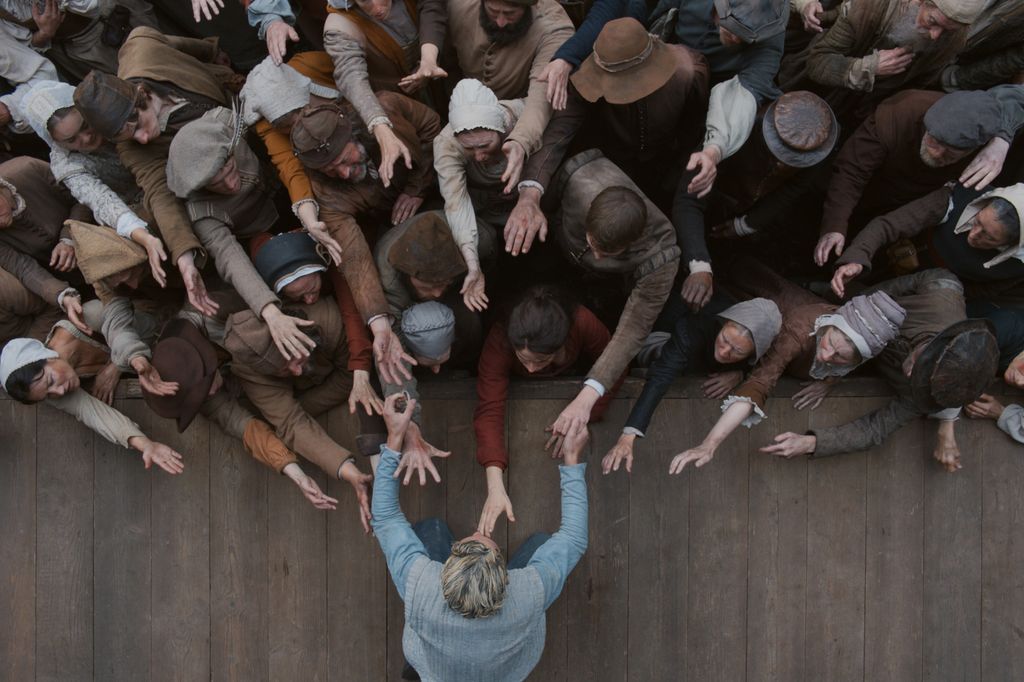
That’s especially true of the climactic sequence, in which a heartbroken Agnes Shakespeare (Jessie Buckley) attends the premiere of the play in secret. She and her husband (Paul Mescal) have grown estranged due to their very different reactions to Hamnet’s death, and it isn’t until seeing Hamlet (which she didn’t even know he was writing) that she realizes he’s been grieving just as deeply as she has. As the actor playing Hamlet — who, in a brilliant bit of casting, is played by Hamnet actor Jacobi Jupe’s older brother, Noah — delivers a monologue, Agnes moves to the front of the crowd and reaches out to him as though grasping at her dearly departed son from beyond the veil. And as the rest of the audience does likewise, the Prince of Denmark returns the gesture in a communal act of grief and catharsis.
It’s at this point in the film that everyone watching has been reduced to a puddle. It’s also when it becomes clear, in looking at this year’s crop of Oscar nominees in general and best picture contenders in particular, that grief provides a powerful through line in some of 2025’s most acclaimed movies. Rather than downers, almost all of these movies provide the kind of uplift that only a good cry can.
None of those cathartic moments come easy. Several other best picture nominees also center on characters mourning loved ones — albeit in wildly divergent ways. In Yorgos Lanthimos’ Bugonia, that comes in the form of a conspiracy theory rabbit hole that drives a confused young man (Jesse Plemons, who should have earned a best actor nod) to kidnap a high-profile CEO he’s convinced is an alien intent on destroying the planet (Emma Stone). Joachim Trier’s Sentimental Value concerns an aging filmmaker (Stellan Skarsgård) who’s never properly dealt with his mother’s suicide as he embarks on his latest project, an autobiographical drama in which he wants to cast his estranged daughter (Renate Reinsve) in a role that may or may not have been inspired by his mother.
Then there’s Ryan Coogler’s frighteningly good Sinners, which is ostensibly a standard vampire flick but gradually reveals itself as much more. It follows a gangster fending off the same bloodsuckers who turned his twin brother into one of their own, with Michael B. Jordan playing both characters in a superlative performance that has him up for best actor (a category he just might win). Weaving poignant thematic underpinnings into the fabric of a crowdpleasing blockbuster is Coogler’s calling card at this point, and it finds the most moving expression of his entire career in this story of a bereaved man fighting desperately not to join his brother on the other side of the veil despite how badly he misses him.
Perhaps the greatest loss of all comes in Train Dreams, which stars Joel Edgerton as a logger named Robert Grainier whose wife (Felicity Jones) and young daughter (Zoe Rose Short) are among the victims of a blazing wildfire. And yet he finds some small degree of solace not only in the passage of time — the movie takes place over more than half a century — but in his realization that he can change along with it. “As he misplaced all sense of up and down,” the narrator intones as Robert takes a ride in a biplane near the end of the film, “he felt, at last, connected to it all.”
The movies, too, can make us feel connected to it all, especially when portraying the kind of experiences that all of us have but few of us know how to process or deal with on our own. Roger Ebert once described the movies as “a machine that generates empathy,” one that “lets you understand a little bit more about different hopes, aspirations, dreams, and fears” and “helps us to identify with the people who are sharing this journey with us.” This year’s Academy Award nominees, especially that cross-section of best picture contenders, exemplify that capacity for connecting with others — the characters may be fictional, but their experiences are universal.
For more articles like this, subscribe to our sister brand Movie Brief, brought to you by resident film critic Michael Nordine. You’ll receive a weekly review and recommendation of a new movie, whether in theaters or available to stream, as well as a list of 25 must-see movies when you first sign up.
RELATED: From Rom-Coms to Nostalgia: 18 Feel-Good Movies to Watch Over and Over Again